Showing posts with label fabric. Show all posts

Sunday, October 11, 2020

IN THE WINDOWS: NINA MARTINE ROBINSON

Neurotangle
by
Nina Martine Robinson


Nina Robinson is an emerging St. Paul based contemporary textile artist whose creative process starts wit a sewing machine.  Neurotangle, created in 2019, is an early exploration into utilizing repurposed clothing as a metaphor for neurodiversity.

In 2018, her 23 year old son was diagnosed with Autism Spectrum Disorder, specifically Aspergers Syndrome. Many individuals on the spectrum have self-soothing behaviors called "stims." These repetitive actions help to calm nerves and soothe them during high stress situations.  For her son, it the the deconstruction of his pants.

"I have spent hours mending belt loops, pockets and patching," the artist reports.

Ms. Robinson's recent installation work is a response to this repetitive behavior. The deconstruction of the clothing and the repetitive stitching create new forms of expression of Autism and neurodiversity as it applies to her experiences. The term neurodiversity was coined to describe variations in the human brain regarding mood, learning, attention, sociability and other mental functions in a non-pathological sense. 

"My goal in sharing these installation is about creating awareness of and being a conduit for interaction between neurotypical and neurodiverse people," Nina Martine Robinson.


Friday, September 27, 2019

IN THE WINDOWS- ART QUILTS


-->
I have known Gwen for over 40 years.  She and I were roommates late in our college years.  She got a degree in Interior Design while I got mine in Fine Arts. She went on to a varied career including institutional interior design and, ultimately, library science.  In the last few years she has returned to her first love: color.  Using the skills of quiltmaking, she investigates how color and form influence each other.


2018-2019 Art Quilts
By
Gwen Schagrin


These works were inspired by a variety of situations: a guild challenge, workshops with art quilting gurus, techniques in books that I wanted to try, improvisational reworking of patterns combined with a new approach to three dimensions, and scrap piecing.

As always, I am motivated to create and explore by improvisationally manipulating color, form, composition, and balance.

The teaching and works of Rayna Gillman, Pam Beal, Jean Wells, and Cindy Grisdela have inspired and guided me.


Tuesday, April 14, 2015

INVENTORY METHODS, in the WINDOWS

INVENTORY METHODS, by Susan Hensel

QR code to take the survey

Gideon stands guard

Gideon wonders what I am up to

INVENTORY METHODS


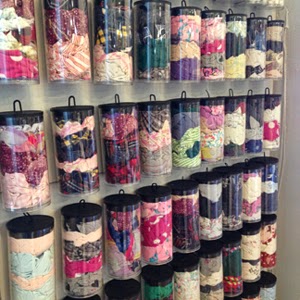
Preparing to install 160 tubes

Preparing to install

INVENTORY METHODS : do the math.

Inventory Methods is an artwork about accretion and subtraction; accumulation and reduction.

It is a record of old pajamas discarded as useless and accumulated as rags.

It is a record of weights, each tube containing 4 ounces of waste materials: rags.

It is a declaration of the beauty that remains in the devalued, worn, discarded.

It is a record of an ongoing process of reduction and a questioning of the nature of what, and who, we devalue and discard.

Each tube represent 4 ounces of weight lost: a reduction in body size, a quest for health and a consideration of the pressures on bodies to conform to cultural standards. 

Gaining and losing weight is very public.  Unless one hides away from the eyes of others, the process is subject to value judgments, comment, encouragement, discouragement, vilification. That which is intensely private and personal, becomes a public spectacle, subject to comment.

With this artwork I want to direct the commenting process, developing community conversation at the intersection of numbers and beauty. I will use a QR code to bring people into an active commenting process.

When did curves become unacceptable?   When did fat cease to represent wealth and fertility?  When did advanced age become frail and disrespected?  When did age, weight, beauty and numbers begin to intersect with moral judgements?

As I lost weight, I wanted to mark the progress, but also name as beautiful that which was subtracted.  I accumulated art as I reduce my size.

There are 160 tubes.  Do the math.


Take a survey to add language to INVENTORY METHODS

Sunday, December 1, 2013

IN the Windows, December 2013

I have always had some problems managing calendars.  I get lost in the days of the week, the months and their corresponding number systems.  For the most part I do get to all my appointments on the right day and at the right time.  But there are glitches.  December is such a month, a glitch month.  I created an unintentional hole in the window schedule.  So, at the last minute, I had to fill the windows.  So this month the work in the windows is mine.
 

These deconstructed suits are part of a series that keeps me thinking and re-working, over and over.
 
I keep returning to them, adding pins, skeletal structures of thread.  I ponder the deconstruction of a symbol of power.

Deconstructing Power

One of the many things that women share world wide is wage disparity with men.  In the US, the average gender wage gap, is 23%.  When considering the wages of CEO’s of Fortune 500 companies, the gap narrows to 17%, but the number of women holding the position also reduces.  Women are roughly 51% of the population in  the US, holding 4.2% of the top positions in Fortune 500 companies.

What is it, then, that represents this overwhelming male power?  Perhaps it is the suit.

Deconstructing Power is a series of stitched assemblages that consider the artificiality of the power suit, designed to enhance male images of power. Developed out of European styles of the aristocracy, the power suit, once established, changed little and now is the near ubiquitous symbol of power for the urban male.  The deconstructed suits are stitched onto floral/feminine upholstery fabrics with their artifice prominent. Once splayed open, they become simply the stuff of which they are made: cleverly woven textiles cleverly assembled for effect, often by the hands of women.